












How to Outsource Your Finance Function Without Losing Control
22 Sep 2026Handing over your finance function as a business owner can feel like a big step, one which is fraught with uncertainty. You’re giving over an important part of your business, along with commercially sensitive information. Understandably, this can be a block for many businesses. The owner or a few other internal members of staff will often be still involved with some part of the finance function, you probably know that if the business grows or becomes more complex you’re current set up is no longer fit for purpose, but still, that level of control feels necessary.
You may be involved in invoicing customers, preparing supplier payments, running payroll and reporting on the performance of the business, even from our clients, it’s common. When you’ve managed these things yourself for years, it is understandable to worry about becoming too removed from them. However, using another firm to outsource parts of your finance function doesn’t mean handing over the reins completely.
A properly structured outsourced finance function gives you a clearer view of the business, outsources some of the day to day, but lets you keep control over the parts that are important to you.
Is your finance setup still keeping pace?
If financial work keeps finding its way back to you, we can review your current setup and show you what could be handled by a dedicated finance team.
Does outsourcing your finance function mean giving up control?
No. You still maintain full control over the business and its finances, but that doesn’t mean every approval or day-to-day finance decision needs to sit with you. If you want a more hands-off arrangement, an outsourced FD can take on more of the operational finance function and agreed approvals, while you retain oversight of the business and the bigger financial decisions.
Your involvement should change, you’ll no longer need to raise every invoice, maintain the purchase ledger or spend evenings checking whether the bookkeeping is up to date.
The control comes from having reliable numbers, agreed responsibilities and approval processes. For example, the outsourced team might prepare supplier payment runs, but a director must approve them in the bank; payments above a set threshold might require two directors to approve; and changes to supplier bank details, payroll, new borrowing and unusual expenses might require separate written approval. Personally completing every finance task can give the impression of control, but it becomes difficult to maintain as the business grows.
A good outsourced finance team should make it easier to see:
- How much cash is available and what is due to leave the bank
- Which customers owe money and what’s being done about it
- Whether revenue and margins are moving in the right direction
- How actual performance compares with the budget
- Where financial pressure could appear over the coming months
- Which decisions need your approval
You should be closer to the information that matters, with less need to manage the process behind it.
What should you hand over, and what should remain with the business owner?
What you hand over and what you keep control of will largely depend on the size and structure of your business. Some owners start by handing over bookkeeping and credit control and then build from there.
Finance work you can hand over:
An outsourced finance team can usually manage:
- Bookkeeping and bank reconciliations
- Creating and sending customer invoices
- Recording bills and maintaining the purchase ledger
- Preparing supplier payment runs
- Credit control and chasing overdue invoices
- Payroll administration
- VAT returns and routine compliance
- Month-end processes
- Management accounts
- Cash-flow management
- Cash-flow forecasting and budgets
- KPI reporting
- Financial information for lenders, investors or board meetings
You can choose the areas where support is most urgently needed, then expand the service as the business changes.
Decisions and approvals you should retain
Business owners and directors would normally continue to approve:
- Payments above an agreed level
- Changes to salaries and bonuses
- New borrowing or finance agreements
- Major purchases and investments
- Annual budgets
- Commercial decisions involving significant financial risk
- Changes to bank mandates or payment authorities
This keeps authority inside the business while the outsourced team prepares the information and carries out the agreed work.
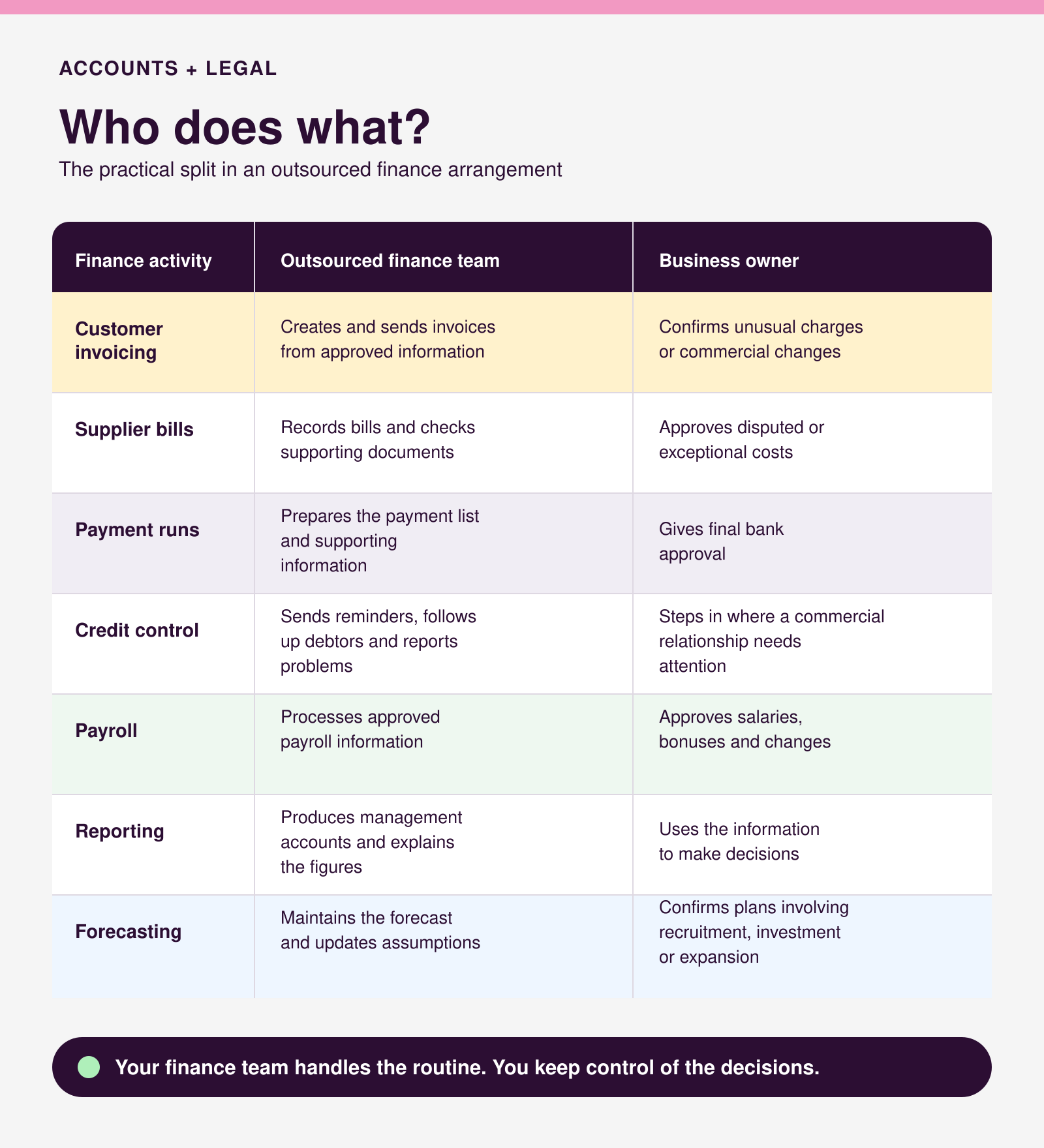
How are responsibilities divided between your business and an outsourced finance team?
There should be a clearly specified division of responsibilities from the beginning. If this is vague, tasks can be missed or pushed back to the owner.
A typical arrangement might look like this:
In-House Vs Outsourced: What’s the real cost for your business?
How do payment approvals work with an outsourced finance provider?
Paying suppliers is one of the biggest concerns we see from owners when considering outsourcing elements of their finance function.
In most arrangements, the finance team prepares the payment run and the business owner or someone authorised will give the final approval. That doesn’t necessarily mean logging into the bank directly, we can use a payment portal that connects the process, giving authorised approvers a simple way to review and approve payments in one place without needing day-to-day access to the bank account. The team checks each invoice against the relevant records, confirms the goods or services have been received where appropriate, verifies the supplier details and records the invoice correctly. It then prepares a payment summary with the supplier, amount, due date, bank details and any relevant notes for the approver to review before authorising the payment.
Approval limits can also be introduced when necessary, for example, routine payments below an agreed amount might follow one process, while larger or unusual payments require additional authorisation.
We also make sure any bank or payment-system access is permission-based, with each person using their own login and an appropriate level of access.
How can you maintain visibility over cash flow and performance?
Your outsourced finance team should give you a regular view of the business, not simply send over a set of accounts. With day-to-day bookkeeping kept up to date, you have a much more current view of cash, debtors, creditors and performance, rather than relying solely on information produced at month end.
For most growing SMEs, that means receiving monthly management accounts alongside an up-to-date cash-flow forecast and a clear explanation of what’s changed. The report should show where performance is ahead or behind expectations, what’s driving the movement and whether any action is needed from you.
Useful reporting might include:
- Profit and loss against budget
- A balance sheet with explanations for significant movements
- A rolling cash-flow forecast
- Aged debtor and creditor reports
- Revenue and gross-margin analysis
- Performance by service, location or business unit
- KPIs linked to the company’s plans
- Commentary on risks and upcoming decisions
We keep your financial information current wherever possible, supported by regular reporting that reflects what is happening in the business now. That means you can make decisions about recruitment, investment and significant payments using up-to-date numbers, rather than waiting weeks for a retrospective report.
We agree a clear month-end close date with you and keep the process moving. If information is missing or a deadline is at risk, we flag it early, explain what is needed and resolve it quickly.
What financial controls should be agreed before handing finance over?
Before handing anything over, the basics of who does what should be agreed with the business owner or directors, the outsourced finance team and anyone else responsible for approving payments, payroll, purchases or financial information.
Questions to consider for business owners are;
Who can create a new supplier? Who checks changes to bank details? What evidence is required before a payment is prepared? How quickly should customer invoices be raised? What happens when a debtor disputes an invoice?
You should also agree beforehand:
- Who can access each financial system
- The approval limit for each director or manager
- How supplier bank details will be verified
- When the monthly accounts will be completed
- How urgent requests should be raised
- Which issues must be escalated immediately
- How documents and approvals will be recorded
- Who provides cover when a regular contact is away
This may sound overly formal, especially if the owner has previously handled finance through emails and spreadsheets but it ensures everyone is on the same page from day one. Also, as the business grows, a clearer process reduces missed work and makes it easier for other people to take responsibility should anything change.
How to outsource your finance function step by step
-
Review your existing finance setup
Before deciding what to outsource, get a clear picture of how your finance function actually works across the business today.
Look at who raises invoices, records supplier bills, manages payroll information and keeps the accounts reconciled. Just as importantly, identify where things tend to slow down, get missed or find their way back to you.
Include the systems as well as the people. Your accounting software, connected apps, spreadsheets and any work handled by employees or separate providers should all form part of the review. This will show you where the pressure points are, what could be streamlined and where outsourcing could make the biggest difference.
-
Decide which responsibilities to outsource
You don’t have to outsource everything at once. Start with the areas that are taking up the most time, causing the most frustration or preventing you from getting the financial information you need.
If reporting is the problem, for example, the bookkeeping and month-end process may need sorting before you can expect better management accounts. If cash collection is becoming an issue, invoicing and credit control might be the more immediate priority.
The right scope is the one that solves the problems you have now, with room to expand as the business changes.
-
Agree access and approval levels
Outsourcing works best when responsibilities and approval levels are clear from the start. Decide who can view information, who can prepare transactions and who has authority to approve them.
You may want to keep final approval over certain payments, or you may prefer an outsourced FD to take on more responsibility within agreed limits. Payroll changes, expenses, new suppliers and larger purchases can each have their own approval process.
Put these rules in writing so everyone knows where responsibility sits and the process doesn’t fall apart when someone is away, the team changes or the business gets busier.
-
Fix the problems before they become part of the new process
Outsourcing an inefficient finance setup simply moves the problem somewhere else. Before the new arrangement is fully up and running, deal with anything that’s making the current process harder than it needs to be.
That could mean clearing unreconciled transactions, reviewing old debtor balances, removing duplicate suppliers or simplifying reporting categories. It may also mean connecting systems that currently rely on manual work or repeated data entry.
It’s better to deal with these issues during onboarding, so the new finance setup starts from a clean position rather than carrying old problems into the monthly routine.
-
Establish a finance routine
Agree when invoices will be raised, when payment runs will happen and what information is needed for payroll.
You should also know when the management accounts will be ready, how often cash flow will be reviewed and who will talk you through the numbers. That way, you know what’s happening, when it’s happening and who is responsible for it.
-
Review the arrangement as the business grows
The finance support that works today may not be enough after another round of recruitment, a new location, an acquisition or expansion into another market.
Review the arrangement as the business develops rather than waiting until finance starts becoming a bottleneck again. You may need more detailed reporting, closer cash-flow management, stronger controls or more senior input as decisions become more complex.
A good outsourced finance function should be able to scale with you, so you can add support when the business needs it without having to redesign the whole setup each time.
Can an outsourced finance team work alongside existing employees or a bookkeeper?
Yes. Outsourcing doesn’t mean you have to replace everyone already involved in your finances.
You might have a bookkeeper who knows the business well but needs help with reporting and financial controls. An administrator could continue gathering payroll information, while the outsourced team processes it. Your operations team might approve purchases before the finance team prepares the payments.
The main thing is to make sure everyone knows what they are responsible for, so work isn’t duplicated or missed.
If you use several providers, someone still needs to oversee the whole process. Otherwise, you could end up spending your time coordinating the bookkeeper, accountant, payroll provider and internal team yourself.
When is outsourcing better than hiring a finance manager?
Businesses often consider outsourcing when the finance function becomes too much for the person currently handling it internally. That person is usually the owner, a director or an existing employee who’s taken on finance alongside their main role.
As the business grows, routine finance work begins to take up more time and become harder to keep on top of. Invoices may be delayed, reconciliations may fall behind and there may be little time left for reporting, cash-flow forecasting or financial planning.
Hiring a finance manager is one option, but a single employee may not cover every area you need. You may require bookkeeping, payroll, credit control, management reporting and senior financial support at different levels and frequencies.
An outsourced finance team can provide access to bookkeepers, accountants, payroll specialists, credit controllers and senior financial support through one service.
Outsourcing may suit your business if:
- The need has grown beyond bookkeeping, but the workload varies each month
- You require several finance skills rather than one full-time role
- Growth is creating more transactions, employees or entities
- You want built-in cover during holidays, sickness or staff changes
- Your reporting needs to improve before you make another senior hire
- You’re preparing for investment, an acquisition or international expansion
An internal hire may be more suitable when there is enough consistent work for a full-time position and the role needs to be present inside the business every day.
If you’re weighing up the options, read our guide to hiring a finance manager or using an outsourced alternative.
What should a growing SME look for in an outsourced finance provider?
Trust and control should be central to your decision when choosing an outsourced finance provider. You need to feel confident that the provider will handle your financial information responsibly, follow agreed processes and give you the visibility and approval rights needed to remain in charge of important decisions.
Some providers focus mainly on bookkeeping and compliance, while others can also manage invoicing, supplier payments, credit control, payroll and management reporting. Make sure the service covers the areas where your business needs the most support.
It also helps to understand who you will be dealing with day to day. Will you have a named contact? Who will oversee the relationship? How often will you speak? When will your reports arrive? If you need help making an urgent financial decision, will you be able to speak to someone who understands your business?
Other useful questions include:
- Where is the finance team based?
- Which accounting and finance systems do they use?
- How will bank access and payment approvals work?
- What is included in the monthly fee?
- Can the service grow with the business?
- Is senior financial support available when you need it?
- How will they work alongside your accountant, lawyer or tax adviser?
- What will happen during the handover?
At Accounts and Legal, our outsourced finance service is delivered by a UK-based team. We can take care of the day-to-day finance operation, give you clearer management information and bring in accounting, tax or legal expertise when a more complex issue comes up.
Is an outsourced finance function right for your stage of growth?
A fully managed finance service is usually most useful when the business has become more complicated than its current finance setup.
Common signs include:
- The owner is still approving or completing routine finance work
- Bookkeeping is being done, but the figures are not helping management
- Reports arrive too late to influence decisions
- Cash-flow forecasting is irregular or depends on a spreadsheet
- Too much knowledge sits with one employee
- Transaction volumes have increased significantly
- The business now has several revenue streams, locations or companies
- You’re thinking about hiring your first finance manager
- Lenders, investors or directors are asking for better information
If your books are several months behind, you may need to get them up to date before an outsourced finance team can take over the ongoing work. And if cash is already becoming a serious problem, you may need more immediate restructuring or rescue advice.
On the other hand, if you only need annual accounts and a bit of bookkeeping from time to time, a fully outsourced finance function may be more than you need right now.
Frequently asked questions
Can I outsource my entire finance department?
Yes. An outsourced finance team can take care of most of the day-to-day work, including bookkeeping, invoicing, supplier payments, credit control, payroll administration, VAT, reporting and forecasting.
You would still keep control of the important decisions, such as approving payments and deciding how the business uses its money.
Will I still approve supplier payments?
In most cases, yes. The outsourced team prepares the payment run and checks the supporting information. You or another authorised person in the business then gives final approval through the bank.
You can agree the approval process during onboarding, including who needs to approve payments and whether different limits apply to different types of spending.
Can we continue using our existing accounting software?
Often, yes. Accounts and Legal is a Xero-first firm, although we can support other systems in some circumstances.
We will review your current setup before suggesting any changes. If your existing software is working well, there may be no reason to switch and create extra disruption.
Is outsourcing finance the same as offshoring?
No. Outsourcing simply means that an external provider manages some or all of your finance work. Offshoring means that the work is carried out in another country.
When comparing providers, ask where their team is based and whether any part of the service is delivered overseas. Accounts and Legal provides its outsourced finance service through a UK-based team.
How is sensitive financial information protected?
Your finance provider should only give each person access to the systems and information they need for their role. Everyone should have their own login, the right permissions and a secure way to share documents.
It is also worth asking how the provider manages bank access, checks changes to supplier details and removes access when someone leaves the team.
How long does it take to hand a finance function over?
It depends on the state of your records, how many systems you use and how much work is being transferred.
If everything is reasonably up to date, the handover may be fairly quick. If there are historic bookkeeping issues or several disconnected systems, the process will usually take longer.
Your provider should give you a clear onboarding plan, including what needs to happen first and when the new finance routine will be fully up and running.
What is the difference between an outsourced finance team and a fractional CFO?
An outsourced finance team handles the regular finance work, such as bookkeeping, invoicing, payments, credit control and monthly reporting.
A fractional CFO provides more senior financial guidance for part of the week or month. They might help with funding, financial strategy, acquisitions or board-level decisions.
Some growing businesses need both. The outsourced team keeps the day-to-day finance operation running, while the fractional CFO helps with bigger financial decisions.
Build a finance function that gives you a clearer view of the business
If finance still depends heavily on you, we can review the current setup and show you where responsibility could be transferred safely.
Accounts and Legal provides a UK-based outsourced finance team covering everything from bookkeeping and payment runs through to management reporting, forecasting and senior commercial support. You keep control of the decisions while we make sure the work underneath them happens properly.
Book a Finance Function Review to talk through your current setup.