












Statement of financial position – Example and guide
2 Sep 2020If you run a business, you’re probably familiar with the term ‘balance sheet’. Depending on the accounting framework and accounts you are looking at, you may also see it described as a ‘statement of financial position’.
The statement of financial position is one of the key financial statements used to understand a business’s financial health. It shows what the business owns, what it owes and the value attributable to its owners or shareholders at a particular date.
In this guide, we explain the main sections of a statement of financial position and how business owners can use the figures to make better financial decisions.
Unlike a profit and loss account, which covers a period of trading, the statement of financial position is a snapshot at a specific date. Statutory accounts normally include a balance sheet at the company’s financial year end, while management accounts may include one monthly or quarterly. Comparing successive periods can help identify changes in liquidity, debt, working capital and the overall financial strength of the business.
Need a clearer view of your financial position?
If your balance sheet is highlighting pressure on cash flow, rising debt or slow customer payments, our small business accountants can help you understand what the numbers mean and what to do next.
Get a free accounting quote and find out how Accounts and Legal can help you make better financial decisions.
Statement of financial position example
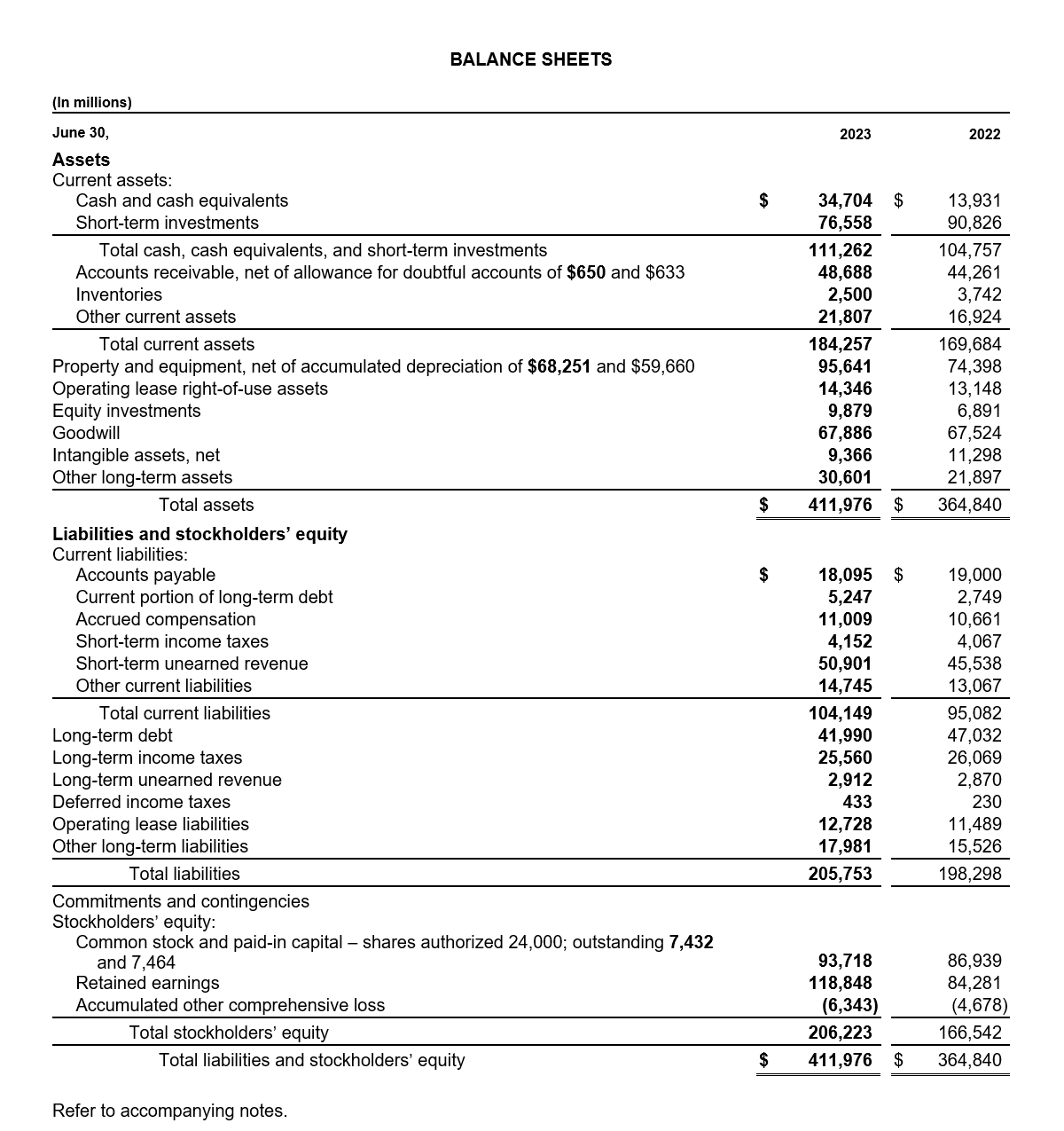
Here is Microsoft’s statement of financial position as an example. The latest completed annual balance sheet is for 30 June 2023 and includes comparative figures for 2022.
Microsoft reports under US accounting rules, so its terminology and presentation differ from those you would typically see in UK SME accounts. However, it demonstrates an important principle: comparing two reporting dates makes it easier to see how assets, liabilities and equity are changing.
When reviewing your own business, avoid looking only at whether the balance sheet has become larger or smaller. Look at what is driving the change, for example, rising cash, increasing customer debts, additional borrowing or investment in new assets.
Read More: Everything you need to know about Creditors and Debtors
Statement of financial position breakdown
The example of a Statement of financial position includes a number of important terms.
Fixed assets
Fixed assets, also called non-current assets, are assets the business expects to use over the longer term rather than sell as part of its normal trading activity. Examples include property, vehicles, machinery, equipment and certain computer systems.
They are generally recorded initially at cost and may then be reduced by depreciation or impairment over time. Depending on the type of asset and the accounting policy used, some assets may also be revalued.
Intangible assets
You may also have intangible assets, which are identifiable assets that do not have a physical form. Examples can include patents, licences, trademarks, copyrights and certain software or development costs.
Not every internally generated brand, idea or piece of intellectual property can simply be given a value and recognised as an asset. Whether an intangible asset can appear on the balance sheet depends on the applicable accounting rules.
Depreciation
Depreciation spreads the accounting cost of a tangible fixed asset over its expected useful economic life. The depreciation method and rate should reflect how the asset is expected to lose value or provide economic benefit to the business.
Importantly, HMRC does not set the depreciation rate used in your accounts. Depreciation is normally added back when calculating taxable profits because it is generally not deductible for Corporation Tax purposes. Instead, qualifying businesses may claim capital allowances on eligible expenditure. This distinction matters when comparing your accounting profit with your taxable profit.
Total fixed assets
This is the carrying value of the business’s fixed assets at the reporting date after accounting for accumulated depreciation, amortisation and, where relevant, impairment or revaluation adjustments.
It should not necessarily be treated as the amount you could receive if you sold the assets.
Current assets
Current assets are assets expected to be converted into cash, sold or used as part of the business’s normal operating cycle, generally within 12 months. They commonly include trade debtors, cash, stock and prepayments.
They are particularly important when assessing liquidity and working capital.
Debtors
Debtors, often described as trade debtors or trade receivables, include amounts customers owe the business at the reporting date.
This includes invoices that have been issued but have not yet been paid, whether or not they are overdue. Other types of debtor, such as amounts due from employees or connected companies, may be shown separately.
A growing debtor balance is not automatically a sign of growth. If customers are taking longer to pay, it may point to weakening cash collection and increased working-capital pressure.
Cash and Cash at Bank
This represents cash held by the business at the reporting date, including money in business bank accounts and any cash held on hand.
Depending on the format of the accounts, cash and bank balances may be presented together rather than as separate categories. Businesses should also distinguish genuine available cash from overdrafts or restricted funds where relevant.
Net assets
Net assets are calculated by taking the business’s total assets and deducting all of its liabilities, not just creditors or current liabilities.
In simple terms:
Net assets = total assets − total liabilities
For a company, net assets should correspond to shareholders’ equity or shareholders’ funds, subject to the presentation used in the accounts.
Current liabilities
Current liabilities are amounts the business expects to settle in the short term, generally within 12 months of the reporting date. They can include supplier balances, tax liabilities, short-term borrowing and the current portion of longer-term loans.
Creditors
Trade creditors, or trade payables, are amounts owed to suppliers for goods and services already received but not yet paid for at the reporting date. The invoices do not have to be overdue to appear as creditors.
Tax liabilities
The balance sheet may include amounts owed in respect of Corporation Tax, VAT, PAYE and National Insurance, depending on the business and the reporting date.
These figures may include liabilities that have accrued but are not yet due for payment, so they should not be interpreted simply as overdue tax.
Loans
Borrowings should reflect amounts owed to lenders at the reporting date. Amounts repayable within 12 months are normally distinguished from longer-term liabilities, which helps users of the accounts understand both immediate and future repayment commitments.
Grants should not automatically be included with loans. Their accounting treatment depends on the nature and conditions of the grant.
Capital and reserves
For a limited company, capital and reserves — often described as shareholders’ funds or equity — represent the residual value attributable to shareholders after liabilities have been deducted from assets.
They can include share capital, retained profits or accumulated losses and other reserves. This is therefore broader than simply the amount shareholders originally invested.
Profit and retained earnings
The profit or loss reported in the profit and loss account affects retained earnings within shareholders’ funds, after taking account of items such as dividends and previous accumulated profits or losses.
Total equity
The fundamental balance sheet relationship is:
Assets = liabilities + equity
Or, expressed another way:
Net assets = equity
Equity should therefore equal assets after all liabilities have been deducted. It should not equal total assets unless the business has no liabilities.
Analysing a statement of financial position
Creating and reviewing your Statement of financial position is not just an accounting exercise, it is an important tool for financial management and it can help you make effective, financially sound decisions about maintaining and growing your business.
In its simplest form, the statement provides an indication of the business’s net assets — the difference between its total assets and total liabilities.
A particularly useful measure for day-to-day financial management is working capital, calculated as:
Working capital = current assets − current liabilities
This helps you assess whether the business has sufficient short-term resources to meet upcoming obligations.
A profitable company can still run into difficulty if too much cash is tied up in unpaid invoices or stock while tax, payroll, suppliers and loan repayments continue to fall due. That is why the balance sheet should be reviewed alongside your profit and loss account and cash flow forecast.
An imbalance here could highlight a potential cash flow issue before it becomes a major problem. You may need to look for additional working capital to deal with the problem.
Analysing liabilities also helps you understand how much debt the business is carrying and when that debt must be repaid.
An increase in borrowing is not necessarily a warning sign — debt may be funding profitable expansion, acquisitions or investment in equipment. What matters is whether the business can comfortably meet interest and repayment commitments from sustainable cash flow.
Useful questions include whether debt is rising faster than profits, whether sufficient cash is available to meet repayments, and whether the business remains comfortably within any lender covenants.
The Statement can provide insight into other important business ratios and trends.
For example, a single debtor figure does not by itself tell you how long customers take to pay. However, reviewing trade debtors alongside sales figures and an aged debtor report can reveal whether collection times are increasing.
Tracking debtor days and overdue invoices can highlight deteriorating payment behaviour early, giving you an opportunity to tighten credit control or payment terms before the issue creates a cash flow problem.
Analysing the Statement gives you an indication of the health of your own business. You can also use the information to compare your performance and your key ratios with other companies in your market. For example, what is the average ratio of debt in the industry and how do you compare? How much capital do similar-sized businesses employ?
Securing funding
The Statement of financial position can have a dual purpose. It can highlight the need for additional funding and help you to secure it.
Lenders and investors will normally want evidence that the business can support the funding it is seeking. The statement of financial position can help them assess existing debt, liquidity, asset backing and the level of capital already invested in the business.
They may also request recent management accounts, cash flow forecasts, aged debtor and creditor reports and several years of statutory accounts. Strong reporting makes it easier to explain how funding will be used and demonstrate the business’s ability to meet future commitments.